Showing posts with label Beijing. Show all posts

Thursday, 23 October 2014

China Flash: Lean In Beijing on the new sexism, corporate ambition, marital choices and awesome girls in modern China

This is a greatly expanded version of an article which first appeared in Time Out Beijing last month.


A Lean In Beijing meeting, image (c) Lean In Beijing
Lean In, Sheryl Sandberg’s book about how she battled corporate sexism to rise to the top at Facebook, has struck a chord with young, ambitious women in China. “I saw Sandberg’s TED talk in March 2013,” says one of Lean In Beijing’s founding members, Allison Ye. “I was shocked because I had never seen a successful Chinese female leader talk with such openness and honesty about how exactly she got there. It was refreshing. Her message was that we can be responsible for our situation and we can control our lives. It was very positive.”

The talk triggered the formation of Lean in Beijing, which sent a survey [PDF]to more than 500 women, asking about their aspirations, their careers and the challenges they experienced in their lives. It revealed that 90% of respondents had never seen a professional women’s network – and wanted one. “We had 60 to 70 women at our first meeting, and every one had a story to tell. Things they wouldn’t tell to their own friends and families, they would tell to strangers,” says Ye. The Lean In message of female solidarity, boosted by speaker events, high social media connectivity, consciousness raising 'circles' and the open discussion of everyday sexism has proven so popular and necessary that Lean In has spread to several Chinese cities far beyond Beijing. Even within the capital, Lean In members have founded their own offshoots like the Lean In Thinktank led by Yolanda Wang and Maggie Zhang and the six Lean In College mentoring schemes founded by Alicia Lui. The mentoring scheme involves bringing in younger professional women to be mentors to college age students, Lui tells me. “Mentoring is a really great way to work through relationship, career and family pressures. At our last event in May, 150 students showed up and we had 15 mentors, all from different industries and with different interests. After the event, lots more professional women wanted to be a part of the network as mentors.”

We are meeting up at a time when gender inequality is back with a vengeance in China, with ancient stereotypes about femininity, double standards about gender roles, endemic and normalised violence against women, media misrepresentation and longstanding pressures on women meeting new corporate injustices around equal pay, property ownership, female leadership and opportunity, as chronicled in Leta Hong Fincher’s brilliant and vital book Leftover Women: The Resurgence of Gender Inequality in China.

Lean In Beijing’s discussions aren’t just about strategising within a corporate context, combating institutional sexism, why prominent Chinese women business leaders stand at less than 5% or why women are paid less than men for the same job. “It’s [also about] the pressure of getting married young, the pressure that’s coming from all directions,” says Ye, “not just the family but the media, the government, society. Every young woman in a family is pressured to get married really young. The message behind it is that a woman cannot be happy by herself, she needs to be someone’s wife, someone’s mother in order to be fulfilled in her purpose in life.” Yolanda Wang agrees: “For a man in China, at the age of 30 you’re meant to have a career, a car, a job. For a woman, the main responsibility is to find someone, to get married. And the pressure on her [to do that] starts at the age of 22 or 23.”

Recently, the journalist (and friend of Lean In Beijing) Roseann Lake co-organised the Leftover Monologues – women’s monologues from all over the world, prompted by a combination of the Chinese women’s movement, Leta Hong Fincher’s work on gender inequality and activist Eve Ensler’s Vagina Monologues. It was the first time many of the Chinese contributors had presented their own stories. “It’s really hard for Chinese people to speak out. They’ll be judged by society as a bad girl, judged by family and friends,” says Maggie Zhang. The Lean In movement in China is radical in itself, for its fostering of open dialogue. The conversation goes far beyond tips on how to negotiate for higher salaries, be less self-critical, manage career progression, handle confrontation or consider a company job versus entrepreneurship - although Lean In Beijing members have discussed all these and more. “The idea is not necessarily limited to work or career, or even family,” says Lui, “it’s more about a close knit, confidential community of women who listen to you, empathise with you and help you.” “Women at big companies are afraid to speak out at meetings,” says Wang, adding, “In the US women sit and talk about their [professional and life] dreams. In China people ask you, ‘Do you have a boyfriend? What does he do?’ Nobody thinks a woman has a dream.” “We asked women how they saw their purpose in life,” says Ye, “and lots of women told us that that was the first time they’d ever asked that question of themselves.”

“Our parents tell us not to get a boyfriend when we’re at college, so we can concentrate completely on our studies,” says Maggie Zhang, “but then, when we turn 25, they pressure us to get a husband.” “I was told, ‘You should never try to be too smart or you won’t find a boyfriend’ by my mother’s friend,” says Lui, “and I was pressured to marry from the age of 26. The family is still considered the centre of everything. I’ve heard, ‘You can’t get a PhD because no-one wants to marry a PhD.’” 

"The other side of the ‘leftover women' story is that we’re moving forward as never before,” says Ye. “Women don’t need a partner to sustain their lifestyles. It’s inevitable that women in China will have more freedom and that this will force change. The post-90s generation is already changing things, they’re really independent. They see that it’s important to have your own thoughts.” Lui chips in, “On one hand China has been one country that’s done the best in equalising everyone to some extent. People’s lives are getting better. But there are problems with the way it’s being done and the consequences. The Chinese haven’t got used to money yet. They want to show off, to show people what they've got. CEOs of companies are in their 20s and 30s. They start a company, they make money. The Chinese mentality-change is one of the fastest in the world, because of the way modern China has started itself up.” “The economy is changing very fast. But society changes slowly,” says Wang. Ye says, “My parents went through the hunger, when they didn’t have enough to eat. That’s why what they want for me is the best: comfort, a husband. When my generation has its kids, it’ll be different.”

While women are regarded as valuable only within the domestic sphere, where their labour can be exploited for free, domestic duties are regarded as demeaning for men to do. “If a man is a stay at home dad, people think he doesn’t have what it takes to go out into the world and support the family. It’s about saving face,” says Zhang. “In Chinese TV shows the man is always rich, tall, successful and the woman is obedient and subservient.”

“There are a lot of social barriers,” Ye agrees when I balk at the idea of individual women changing themselves in order to somehow evade, circumvent, win out against or contend with endemically antiwomen structures, judgements, customs, stereotypes and activities. “We can’t change the outside of society very fast but within our generation and the next we can change the policy-makers of the future. There’s only so much one person can do, but if everyone plays their part you can change a lot.” However, the barriers to equality and liberation are high. “You are discriminated against as a single woman,” says Ye. “Single women are barred from adoption. Sometimes a woman will choose her family over her career. Or she’ll choose her career. But women aren’t allowed to be both.” Yolanda Wang’s company asked one of her female colleagues to sign a piece of paper promising that she wouldn’t get pregnant for two years. “We never hear about men’s work-life balance, only women’s. And you’re judged badly whatever you choose,” she says. Maggie Zhang adds, “We have to educate not only women but also men, who are under huge pressure to be successful.”

Alicia Lui believes that Sheryl Sandberg’s inspiring talk and book have “raised issues which enable us to have more open conversations about [sexism]. Lean In was a catalyst. It said to women, if you really feel you have a need for something you have to raise your hand and ask for it.”

Ye believes the movement is a chance for women to look at their lives afresh: “Before you change anyone’s life you have to change the way they see themselves. We have high rates of employment for women here, but sometimes women are happy with less demanding hours and less pay, because it means they still have time to do all their family duties. I believed all that too – until I was brave enough to say that that was not what I want. Once people see alternatives then they can begin to lean in and change their lives. We want to help women pursue their own definition of success, help them when they’re young and share stories of other women’s lives so they see themselves in these women.”

Lean In Beijing derives its momentum and power from its focus on co-operation between women. “Why do women judge each other?” says Allison Ye. “We don’t have that tradition of women helping women.” “We support each other to take the next step,” says Alicia Lui, “but starting something requires the other side to response. I argued with my mum [who put pressure on me to marry] and now she’s coming to understand my thinking. Each of us has a personal stake in Lean In Beijing because these issues affect us personally.”

Yolanda Wang says, “At my first Lean In Beijing meeting I realised I’m not on my own, I’m not crazy. Women are so honest, so encouraging, they push you to change things. For women it’s very hard to be their real self. Who they are now is who their family wants them to be, who society wants them to be. The cliché was that the only thing between girls was jealousy. But that’s not true. It’s so good to see girls who say to each other, ‘I like you because you’re awesome.’”

For a full list of my China Flash series of articles about contemporary China, please click here.


Saturday, 18 October 2014

China Flash: Film-maker Jenny Man Wu on contemporary Chinese women’s wit, pain and ambivalence

This is a greatly expanded version of an article which first appeared in Time Out Beijing, where I am currently doing a stint as Deputy Editor.

Jenny Man Wu is a film-making powerhouse, describing her work as “soul led, not fantastical or abstract” and “inspired by a European arthouse sensibility in terms of the acceptance of the director as an auteur, rather than the Hollywood sensibility where a producer is the most important person and decides on the cast, the setting, the marketing and the distribution. It’s not important to me to make a million dollar movie. I want to continue to make low-budget movies where I have the right to do what I want, to show to and influence a certain small number of people. When I consider the price and sacrifice a director needs to pay to have a high budget cinema-style movie, I can say no to that. And if you’re making movies that you want to be screened in China you have to submit to censorship from the government.”

Over the course of four punchy short films, Man Wu has garnered international attention within just a few years of graduating from her studies in screenwriting and literature at Beijing Film Academy. Some Sort of Loneliness, A Choice (Maybe Not), Crime Scene and Last Words, all produced between 2012 and 2013, feature women in the throes of tragicomic contemporary despair. “It all starts with very little things, small daily situations,” says Man Wu. “Then I start to describe them, to look at them from a different angle.” In A Choice (Maybe Not), two young women are in a coffee shop, “and one of the girls is a little bit OCD about the choices she makes. She doesn’t want coffee. She doesn’t want lemonade. The beer is overpriced. The wine’s been open for two days. It's a comedy but it’s really about the pressure on women to choose. Women in the olden days almost never walked out of the house alone – and now we have all these choices, it seems. But there are so many choices it's hard to tell if you've made the right one or not. And sometimes when you're forced to make a big decision it's easy to put it down to fate, to the inevitable or the subconscious.”

Last Words, a monologue which Man Wu acted in herself, examines the notion of choice in a far darker way. “It’s a stream of consciousness, a woman talking about suicide and presenting her last words. She’s thinking about something [abusive] that happened in her childhood. The core of the film is not about how she develops her obsession with suicide but her recent experience of domestic violence, her struggle with her parents and the restraint she’s experienced from her father. It’s about how a female wants to have a different kind of life, about her struggle against patriarchy and disappointment and her desperation about her future. She feels that suicide is the only thing that she can do because she’s a perfectionist and an idealist – and these beliefs make her suffer all the more. At the end, she looks into the camera and asks, If I kill myself, does it mean I’ve surrendered to the world?”

Man Wu is committed to focusing on the issue of gender in China. “I have a political view about gender in general and that comes through in my work. Gender issues are political issues. I have a responsibility: I understand how it is overseas and how it is in Beijing and feel I must connect the two, to show that women could be living in so many different ways. We had a women’s revolution in China in the 1920s but all this did was release free female labour into the market.” In giving voice to the ambivalence, pain and wit of her women characters, Man Wu points out that she is going against society’s assumption that “women’s feelings and emotions are small and not political.”

When it comes to gender, Man Wu “can’t say it’s going backwards. It’s very complicated, how [society] sees single women. It’s related to capital and economics. It’s also that under the one child policy, girls do feel cherished within their family, they are insulated and protected from the frustrations of gender inequality at a personal level, so many don’t understand why they should fight for their rights. But it’s important to recognise that a lot of the problems in daily life are actually related to gender. For example I know of a young woman at school who wasn’t a virgin. But she was with a new boyfriend and to pretend to be a virgin, she put some [red] colour in herself – and the colour wouldn’t wash off the guy! And this was presented as a big joke by the guy’s friends. But there’s a double standard: girls really are expected to be virgins.”

Man Wu was selected to show at the 2013 Beijing Independent Film Festival, has just got back from the high profile Elles Tournent Film Festival in Brussels and is currently directing the Beijing Queer Film Festival, which will be running at various venues across town until December. However, both the Beijing Independent Film Festival and the Beijing Queer Film festival have both been shut down by the authorities on their launch dates in the past. One typically clever strategy for circumventing this possibility has been to screen films on special buses driving around the city; yet another example of the ingenuity which has developed in China as a response to the caprices and controls of those in power.

“I can’t leave Beijing,” vows Man Wu. “A lot of things are happening here. I see the changes and they’re not always good. It’s sad to see old buildings being demolished, places becoming more commercial. It’s always good and bad – but that’s what makes the world interesting. As Dickens wrote in A Tale of Two Cities, ‘It was the best of times, it was the worst of times.’”

To read my China Flash series of articles about contemporary China, please click here or explore some of the links below:

Tuesday, 7 October 2014

China Flash: Benedicte Bro-Cassard, Beijing fashion photographer, on the Chinese luxury market, sugar daddies and sugar daughters

This is a greatly expanded version of an article which first appeared in Time Out Beijing.


Archive: Marpessa by Bénédicte Bro-Cassard

Bénédicte Bro-Cassard is fashion. Occasionally going by the pseudonym Gabrielle Bonheur (an in-joke for fashionisti - Gabrielle Bonheur was Coco Chanel’s formal name), Bro-Cassard is the brains and eye behind the style site Fearless In Beijing. Fearless combines stingingly hip street shots of the highly styled, label-toting girls of Sanlitun with fresh profiles of new designers and sharp commentary on modern China and modern fashion, boosted by all the wisdom gleaned from her thirty year fashion history in New York, London and Paris. Fearless In Beijing currently features in Le Monde, Vogue China, Louis Vuitton’s City Guide and mega Chinese tech site Sina.

The roaring 1980s, Alaia and his 'best girls'
by Bénédicte Bro-Cassard
Whether it’s scouting beautiful girls on the Chinese capital’s streets, covering the kitsch wedding photography industry, hunting down hilarious fakes or finding forgotten rolls of classic supermodel shots in her basement, discovery is the name of Bro-Cassard’s game. Beijing is soon to enjoy two exhibitions of around fifty of Bro-Cassard’s photographs both from her current Beijing adventures and her 1980s student days at Parisian fashion school Studio Bercot, when she hung out at the ateliers of Alaia, Montana and Dior, shooting the designers and models clowning, preening, draping and creating. I ask why Bro-Cassard almost never features herself in these images and she’s adamant: “I have four hundred pictures from my early days and there’s only one shot of me. It’s with a camera in front of my face, in a refection in a make-up table, when I was shooting one of the girls. I’d have my picture taken with my friends who were supermodels, they’d look at it and marvel, ‘Wow. You reject the light.’”

The images are notable for their classiness, the womanliness of the models and the sense of maturity, camaraderie and sleek but unexploited hedonism they exude. Some of the prints have been eroded and nibbled in at the edges by time, but the women are as chic as ever. As Bro-Cassard tells me, “Back then the cabine [the stable of models] was incredibly diverse and not so white on white as it is now, and the 'girls' were aged 17 – or 16 in the case of Stephanie Seymour – up to 34 and older, like Mounia, Janice [Dickinson] or Alva [Chinn], even pushing 40 like [Farah] Zulaikha – and 40 was pushing back hard. I have pictures of Grace Jones and Azzedine Alaia and the supermodels of 1985 playing around backstage. It was truly different then.”


Archive: Katoucha by
Bénédicte Bro-Cassard
From those early days in Paris, Bro-Cassard moved to New York where she spent fifteen years as a fashion manager, stylist and sales executive for the likes of Romeo Gigli, Fendi and Anna Molinari, “Back in the days before Sex and the City became a documentary and no longer something to laugh at for entertainment.” Next came a move to London, where Bro-Cassard was in charge of international buyers for London Fashion Week. Among her clients were commercialism-savvy design wunderkind Christopher Kane and the crisp, clever Boudicca. A move back to Paris saw her working as a fashion consultant for the Brazilian government, working with them to develop their fashion industry.

A change in family circumstances saw her coming to Beijing a few years ago, after a very brief stopover in Geneva, “where fashion goes to die.” In China, Bro-Cassard has witnessed a country in the middle of extreme and rapid transformation: malls springing up on every corner, the breakneck development and expansion of major cities, prestigious French and Italian brands unveiling glossy new boutiques and advertising campaigns, the high taxes on luxury items hardly deterring a young and newly rich populace hungry for everything their parents never had. Bro-Cassard was immediately captivated: “I spent a year studying the streets, going everywhere that there’s a market selling clothes, to find out what the Chinese wear, what makes them tick. And I just fell in love with these girls, because they were so cool. I began documenting the girls and the fashion habits of the young Chinese. They’re free. It’s not even like the Swinging Sixties here. It’s the Roaring Twenties, where money can be made overnight. They party, they have fun, there’s a curiosity. They’re fearless – that’s why I named my site after them.”


Image from Fearless In Beijing
by Bénédicte Bro-Cassard

Image from Fearless In Beijing
by Bénédicte Bro-Cassard
Bro-Cassard tells me that her appreciation of these young women is genuine. They are not the empty, uncreative consumers they are represented as in the international media. “The gorgeous thing is that they’re never vulgar, never cheap. The [pejorative] fantasy of these young Chinese women is that they are logo hungry, stupid rich girls. But I think they’re more fun, more clever than that. They take more risks. Then I go back to Paris and everyone’s dressed in black.”

Despite Bro-Cassard's positivity, I’m disturbed by some of the young women I see in Sanlitun. While some are the cool, creative, independent type that can be found in any major city in the world, others are dolls - which I Freudianly mistyped there as 'fools'. They are in designer labels, perfectly coiffed, photo-ready, made up, silent, styled and accessorised, just walking slowly from one end of the Taikoo Li shopping ‘village’ (trans: huge black futuristic mall) to the other. They don’t sweat, even in the roasting 100-degree summer heat. Apparently they have nothing to do, no studies, no work, no projects. They don't talk or laugh with their friends. They mill about, gorgeous and passive, waiting to be noticed, photographed or picked up - and when Bro-Cassard and I stop them to ask for photographs, they offer themselves up as passive objects to be snapped, without a single word. They don’t ask us what blog it is, who’s running it, who’ll be reading it. They don’t tell us anything about themselves as people, nor do they ask questions of us as people, nor do they crack jokes. They’re not confident, they’re not coy, they don’t simper, they don’t frown, they don’t laugh, they down clown around. They simply pose, like hollow plastic mannequins, inert and endlessly compliant. When we ask one girl to pretend to be texting, because we want to get a shot of her iPhone case – Moschino, rubber, styled to looked like a packet of McDonald’s fries, available in the shops maybe only last week – she does, without a word, putting her thumbs to the blank screen and pretending to concentrate. When we say thank you the girls drift away, down the escalators.

Image from Fearless In Beijing
by Bénédicte Bro-Cassard
Where did these girls get their money from? Why are they copying their looks wholesale from fashion magazine spreads? What do they do all day? Beijing is the first place I’ve seen teenagers walking on the street wearing real Chanel from head to toe. Who are these girls waiting for, going to or coming home from? “Their daddy, or their boyfriends, or their sugar-daddies,” says Bro-Cassard. We stop another young woman, striding in spindly gold high heels and a long printed chiffon dress, clearly in a rush. “Er – she was late for a date. That she was being paid for,” says Bro-Cassard after quickly snapping a shot.

She tells me not to judge: “Years ago, nobody had food. Twenty years ago, nobody had money. They’ve had famine, purge, cultural revolution, which is the earth opening up and everyone falling into hell. So there is no concept of nouveau riche. Nobody ever had money. I’ve been to the countryside in China, it’s fucking poor. It’s real, it’s a favela. I went to our ayi’s [maid’s] house, it was 2 rooms, no kitchen, no bathroom, far out of the city beyond the ring road, but it has pictures, it as a light. [Internal] migrant workers are even worse off, they’re like the untouchables in India. In summer they sleep in the streets. In winter they sleep in parking lots. But because it’s China, it’s all behind closed doors. I once wandered into the back corridor of a shopping mall and there were people living there, ayis were sitting knitting.”

“Whatever money you have, you know that little brass ring is gonna burn your finger sooner or later, so enjoy it while you can. Of 1.4 billion people, only a tiny amount will make it. Because they are so scared, they know they can lose it at any moment. So these girls live to spend. And they have no religion, although the government is beginning to address that: how do you give values to a society that has no value except money? As far as these girls are concerned, they’ve made it.” Bro-Cassard reminds me, “This is the first generation that gets to dress how they please. They are expressing themselves with their clothes. Their mothers were raised by their grandmothers, who looked like their grandfathers.”


Image from Fearless In Beijing
by Bénédicte Bro-Cassard
"One thing I’ve realised, living here," she says, “is that if someone seems rich, he’s even ten times richer than you think. Imagine, you’re a young woman, your father was just a farmer. He sold his land for a factory to be built on it, now he’s worth so much.”

Despite this sudden spike in wealth creation, I balk at the gender politics and power structures of the newly moneyed world and the way it has warped girls’ and women’s lives and led to such demeaning survival strategies. “Men have the power here,” states Bro-Cassard. “Girls hang out looking for sugar daddies. This is the second-largest market for plastic surgery in the world, after Brazil. Their mentality is that they need somebody to pay for their life. If you’ve come from poverty and suddenly your boyfriend or father gives you a credit card with no limit, you burn through it.”


China Flash: Kong Lingnan, Beijing painter, on natural beauty and human ugliness

This is an expanded version of an article which first appeared in Time Out Beijing.

O Brambles, O Brambles, by Kong Lingnan (2012)
Indulgence is hardly what one would associate with the prolific, rigorous artist Kong Lingnan, who lives and works in a chic warehouse space in the 318 International Art Village, a Beijing zone so cutting edge and (literally) far out that it’s still being constructed by hard-hatted, belly-baring builders. Kong’s visually stunning large-scale paintings replicate the eerie, sexy effect of neon tubing. “I was trying [unsuccessfully] to draw portraits, until one day I saw a neon light in front of my window, glowing in the darkness, spelling out the Chinese character for ‘spoil’ or ‘indulge’, and it struck me as funny.”

Unnatural, electric neon proved to be Kong’s natural language, the one she uses “to describe the world.” That world contains equal parts terror and beauty. Her style has developed from epic landscapes in which tiny humans are caught up in scenes of male violence (particularly male sexual violence against women), natural disasters and accidental devastation to globular, seemingly abstract images where a bird’s-eye view of islands resembles amorphous biological cells. “I don’t want to be narrative at all. I want to describe a state,” she explains.

Over the last five years Kong’s work has made her an art market must-have, a favourite face in Vogue magazine (when photographer Peter Lindbergh recommended her to Vogue China’s Editor in Chief Angelica Cheung following a group art show with Kong), a collaborator with the Chinese fashion label JBNY and the headliner of a solo exhibition, Beach, at Beijing’s Gallery Yang in the 798 Art District, which ends on 10th October.

When I point out the sinister elements of her work and the conflict they portray between nature and the human world, Kong agrees: “I am very sceptical about all the things we’ve built. Our culture, our moral standards, our religions. We’re building, building, building – and coexisting with nature. A human is just a tiny creature. We can be strong, but also very fragile.”


To read my China Flash series of articles about contemporary China, please click here or explore some of the links below:

Sunday, 5 October 2014

China Flash: Writer Kerry Brown on the seven elite men who rule a country with Communist roots and capitalist shoots

This is a greatly expanded version of an article which first appeared in Time Out Beijing.

Kerry Brown has been a China hand for two decades now. Formerly head of the Asia Programme at Chatham House in London, he also worked for the Foreign and Commonwealth Office in London and Beijing and is now Executive Director of the China Studies Centre at the University of Sydney. He has gained expertise and shared his insights not only in diplomatic politics and academia but also in the literary world, speculating on the future of Shanghai in Shanghai 2020 and collecting voices from across China in Carnival China, an essay collection reflecting the country’s recent social, cultural and ideological transformations.

Brown returns to Beijing this month to discuss a project that may constitute the riskiest move of his career: The New Emperors: Power and the Princelings in China, published this year by I B Taurus. The New Emperors examines the culture of the ruling Communist Party and the personal and professional histories of the seven men elected to the Standing Committee of the current Chinese Politburo in 2012. Brown describes an insular network of wealthy, strategic careerists whose existence is dominated by an all-consuming political culture which absorbs all their ambition but isolates them from the lived reality of the country.

The New Emperors is a fascinating, subtle and timely insight into the most delicate relationships: those between the rulers and the ruled; between politicians’ personal ambition and adherence to the Party; between Communist roots and capitalist shoots; between what is asserted publicly in theory and practiced in secret; between stated ideology and private values; between the mechanics of control and strategies of evasion and subversion; between the major cities and the provinces, local and national; and between the privileged minority and the struggling majority.

Brown reveals a world in which it is possible to rise to the top of a massive communist organisation while remaining firmly within the patriarchal boys’ club and collecting lucrative business stakes, innumerable off-the-books perks, plentiful sexual exploitation opportunities, shady accomplices and a diversity of ideologically, politically, financially, socially, culturally and morally dicey interests along the way. These guys wear their inner and outer hypocrisy as easily as the regulation black hair dye and heavy tailoring which render them deliberately identical in the public eye.

The book hasn’t been translated into Chinese and probably hasn’t been read by the ‘princelings’ and ‘new emperors’ themselves. However, given the targeting of those within China who write critically about politics, I am skeptical when Brown tells me the only risk he has undertaken in his work is ‘an aching hand from typing so much’. When he arrives in Beijing for an event at the Bookworm on Wednesday 15th October, his discussion of The New Emperors will necessarily include issues which the Party deems sociologically sensitive. In advance of that conversation, in which I will be Brown’s interlocutor, he shares his thoughts on China’s past, present and future.

Your first visit to China was as a teacher exactly 20 years ago. How have you seen it change in that time?

The China I lived and worked in 20 years ago was on the cusp of its great economic awakening: here had been reform for over a decade, then the shock of 1989, the withdrawal of many foreigners and the end of the relatively liberal era of politics in the 1980s. The city I was based in for two years, Hohhot in Inner Mongolia, was pretty sleepy and represented the ‘half awake’ atmosphere that prevailed at the time: lots of qualified expectation and hope [which was] still weighted down by the unfortunate events of the last few years. There was one ersatz fast food place in Hohhot, a sort of local rip-off of Kentucky Fried Chicken, then large swathes of the city that were pretty makeshift and ramshackle and looked like they could be blown away in a strong gale.

If you visit Hohhot today the whole place has been rebuilt almost from scratch. Materially, on the surface, China is dramatically different today compared to then. But in the habits and thinking of the people, I think the change has been less dramatic than we think. Networks around you [which enable you] to get by in society were important then and they remain so today. The only difference is that in those days the most powerful person in the city seemed to be in charge of the local station ticket office, because it was so hard to get train tickets. These days, it must be the local Louis Vuitton boss who is the person everyone wants to know, or the director of the Inner Mongolian Apple outlet.

Have you also witnessed a transformation in the way the rest of the world views China?

The world outside could largely ignore China in 1994. I remember speaking to an eminent academic in the UK back then, after I got back from China after two years living there. When I suggested we might need to study China's language and society more and prepare for a future in which it was a more significant global player, he laughed aloud and said, “Well, people have been saying that for two hundred years.” It would be impossible to make this sort of dismissive comment so sweepingly now. But I suspect the same old misgivings and misperceptions of China as some kingdom of otherness still prevails, despite the fact that its people, culture and impact are in our daily lives outside of China much more deeply than they have ever been before.

What do you think underlies the Western stereotype of China as avaricious, inscrutable and alien?

Stereotypes of China have always carried this slightly unsettling element of inscrutability and unknowability. Films and plays in the past, like the notorious Fu Manchu figure from the 1930s, distilled this. It’s odd that these ideas can still linger when you think that in the UK, US and Australia, ethnic Chinese have been part of our communities for well over a century and a half.

Perhaps some people feel a deep need to have these distorted but dramatising images buried in the recesses of their imagination to liven their lives up. But it is a very deliberate and perverse act to maintain in a world where China and its people are in fact so visible, accessible and knowable.

You have engaged with China not only as a writer but also as a diplomat and an academic. What is it that draws and keeps your interest?

I find it to be a world of surprising surprises. It is a place where the things I expect to find startling often feel very familiar - like relating to people, despite the cultural and historic differences. Things which I expect to find familiar are often baffling – [for example] I have never really worked out what many Chinese really think of the outside world.

The New Emperors focuses on the seven men who essentially run China. What is these men's remit?

The seven men in the current Chinese Politburo are best seen, as I interpret them, as in charge of the big vision or strategy for their country. They sit almost like the board of some massive company, signing off the broadest general directives but living in a zone where administrative or specific policy implementation is left to others. They are, in many ways, the guardians of the values and legacy of the Party. We forget that in this context their individual aims and ideas have to be subsumed within this entity to which they owe everything and which they must faithfully serve: the Communist Party. The Party is the strongman in modern China, not Xi Jinping.

What kinds of lives do the members of the Communist Party's upper echelons live?

I suspect [their lives] are dominated by calculation of who they can trust and who they must be wary of. Theirs is a very insecure and often pretty merciless political culture. And once they enter this realm, they can never leave it - not willingly, anyway. In that sense, it is an extraordinary cage they are in.

How did they rise to power?

They rose to power by accruing political capital across different constituencies and networks in the party. Former leaders, particularly figures like Jiang Zemin, [comprised] one of the key groups amongst the [various] constituencies the current leaders had to recruit to get where they are. In the 2012 leadership transition it was clear that in the end, as a kind of circuit breaker, Jiang and other senior retired cadres had a consultative role. This might have been no more than nodding through one candidate or pausing and damning another with faint praise. 

[The seven men] have reached their current position by making many friends and avoiding building up enemies, but also by avoiding binding commitments that marry them to interests that they have to satisfy when they finally reach the summit. In that sense, these current leaders have shown, mostly in provincial careers, the ability to serve but not belong. They carry out the Party's mandate, but they cannot be the servants of anything except it.

How do the current Politburo Standing Committee members benefit from their power and do they share these benefits?

Of course, having a link with someone elevated to the Standing Committee of the Communist Party of China is a great asset and plenty of people overtly - or more often than not covertly or subliminally – try to leverage this in their business or other work. One day we can probably work out the dollar value of having a powerful authentic link to members of the political elite. But the general rule now seems to be that those who have such a link preserve its value by letting others allude to it and broadcast news of it while they keep silent.

You describe the indifference you witnessed among ordinary people in a Beijing hotel when the latest seven were elected. Why do you think they were so apathetic?

I suspect people felt disengaged by the 2012 leadership transition in China because it was something decided in ways that were very remote from their daily lives. This was not a universal franchise election where at least there were campaigners trying to engage with people, get their attention and wrestle their vote out of them. It lacked that link.

The current political system tries to do too much with too little. In the future, power will need to be shared out more widely. At the moment it is concentrated in the hands of too few, and they are unable to really continue making the quality of judgments that people in this society are increasingly demanding.

Walking around Beijing I am always surprised by the visible wealth of many of the young people in certain areas. Where does this wealth come from? 

The Party has created a society where almost anything can now be monetised. Perhaps that is the meaning behind the words of the Plenum last year: the ‘perfection of the market system’. In China, this means today that everything is in the market, from relations between people to education and marriage; there is no area of life that does not involve some sort of financial transaction. The puzzle for many in the manic market of China today is not why there are so many wealthy people, but why poverty still exists. To get rich is now glorious, and normal. I am sure the wealthy elite in cities or elsewhere in China are genuinely puzzled by how it is even possible to be poor in China now.

How do the communist and capitalist aspects of the country coexist?

Communism provides the elite with a common ideological and moral language that they can talk to each other in and concepts which can unite them and which derive from China's recent history [my addition: even if they live in a way which is completely and cravenly counter to the ideology, morality, conceptual framework and nationalistic devotion which they pretend to share]. For everyone else, this is like Latin in the medieval Christian church: something only the priesthood understood but which the rest of society didn't need to understand or know. They just had to take on trust what they thought was being said, and get on with their lives. The parallels between the Catholic church and the Communist Party are quite striking in many ways. Probably a good subject for a future book…

How would you categorise China? A capitalist country with a totalitarian core? A bureaucracy with a communist rationale?

I would categorise China by admitting it resists all categorisation. In some subtle ways it’s a unique system because of its scale, speed and complexity. It is [also] clear that our external categorisation of China carries little weight within the country itself. I was at a discussion on ‘fragmented authoritarianism’ with some Party officials and foreign scholars some months back. When the phrase was finally translated into Chinese, the Chinese officials looked genuinely perplexed. We have still failed to find a term for China or a framework in which those inside and outside the political culture here both agree on what it actually is.

What are the principal misconceptions the West has of China?

I think the West, or principal figures in the West, fail to see that while the Communist Party may well not be particularly loved by many Chinese people, when it appeals to the desire for China to be a rich, strong country it speaks a language that most people in this complex and often highly uneven society find appealing and unifying. We underestimate the desire for many Chinese people to have a strong status for their country - that is as much an emotional as a political desire. Underneath the surface, unity is lacking in China - it is a society where change has been too fast, where mobility has been huge, where people live in a place where they were not originally from and where cohesion is very fragile. This is a society where there are simmering frustrations and the need to create a sense of unity that doesn't just end up being a shrill nationalism is very important. That probably involves the state disappearing even more from people's lives as they seek new and more creative ways to become modern, global citizens.

Do you think that foreign countries criticise China for things that they themselves are guilty of? I’m thinking of nepotism, political corruption, extreme capitalism, too-fast development, commercialism, excessive police/army/state power, opposition to grassroots movements, surveillance culture…

There are a lot of double standards and hypocrisy with some of the international criticisms of China, just as there is a lot of defensiveness or wariness in the response to these criticisms by Chinese officials and elites. As the world's top emerging economy, however, they will just have to put up with attacks like these. It comes with the territory.
To read my China Flash series of articles about contemporary China, please click here or explore some of the links below:


Friday, 3 October 2014

China Flash: Writer Zhang Chao on media misogyny, China’s momentous social changes and the pressures facing young Chinese women today

This is a greatly expanded version of an article which first appeared in Time Out Beijing.

It took an earthquake to make Zhang Chao a writer. She is now an acclaimed journalist with nearly fifty thousand followers on Wechat and Weibo and is celebrating the release of her book Silent Golden Age, published by Xiron in October. Six years ago, she was staring tragedy in the face. “In May 2008, on the day of Sichuan Earthquake, my mom was having surgery. Thousands of people had died in this disaster and I was still waiting for my mom to wake up. That's when I decided to ignore my fears of failure and criticism and start living my life to the fullest.”

She always wanted to be a writer, but “having any kind of dream can be kind of terrifying.” Yet this terror is the source of her insight. In her sharp, punchy writing Zhang examines her own post-80s and 90s generation, which is “living out their golden age, but not having their voices heard by society. Young people, especially young women, are caught between their own dreams and society's expectations of them. I find it interesting how people choose, how people face heartaches and hardships, how people fight against and cater to society.”

Despite her success on social media and the highly Netty habits of today’s young Chinese readers, Zhang maintains that it is not important for 21st century writers to use social media and that is not writers’ own responsibility to increase their impact: “[Chinese social media networks] WeChat and Weibo and Facebook are merely platforms, and are not that different from traditional publishing. Things online can be very misleading, especially in this day and age, when information can travel so quickly. Even if a million people read your article it doesn't mean that it was good. For writers, what matters the most will always be the compassion and thought reflected in your work, everything else is a bonus. As a writer, you should focus on content - reach and social media is for the publisher.”

Describing her beloved Beijing as “the only city that can see all of my scars,” Zhang is inspired by China’s fast-transforming capital. “When I read E. B. White's Here is New York, all I could think of was my experience in Beijing. The first time I came to Beijing was 20 years ago. Back then, the city only had two subway lines. I moved here after graduate school, and since then I've lived in five different apartments, changed jobs twice and added about a thousand people to my phone contact list. The city saw me grow up, saw how I got lost and found my way back, how I fell and stood up again. Beijing knows the wounds and healing that came before.”

Zhang’s articles cover everything from food to football, social justice to sexual equality, love and sex to the arts and culture and everything in between. “What my more popular pieces have in common is that they focus on female independence and empowerment,” she says. “Most of my readers are young, intelligent, well-educated professionals. They are pushing a social movement here to encourage our generation of women to challenge tradition. I use my personal experience to prove that all limitations only exist in our head. We have the power to change culture and tradition.”

Despite her ambivalence about social media, Zhang’s influence is rooted in the impression that she is communicating directly and candidly with readers who are peers and contemporaries: “The stories I share, they've been happened to them before. I just help them say what they want to say, because I am one of them.”

Zhang has suffered from the misogynist backlash which seems to be an endemic and very telling feature of online life all over the world, especially when women writers address misogyny. “The most criticism I ever received was after publishing my thoughts on Eve Ensler's TED Talk ‘Embrace Your Inner Girl’. What I didn't expect was the mockery and verbal abuse from some male readers. They made me realize that in China, many men and women are far away from being equals, and female independence can be a very dangerous thing to these men, because they're not ready to share the power or to give up any control.”

Zhang’s ambition is to examine the “momentous” social changes China is undergoing and their effect on ordinary people. “Both the unrelenting spirit and weakness in humanity are being shown up more obviously than before. Materialism, idealism, collectivism and freedom are all big words which are [actually] deeply integrated in people's real lives. I want to write the untold stories, so my readers can remember what China was and understand what it will someday be. I’ll keep writing until the day I die, that's who I am.”

To read my China Flash series of articles about contemporary China, please click here or explore some of the links below:


Wednesday, 1 October 2014

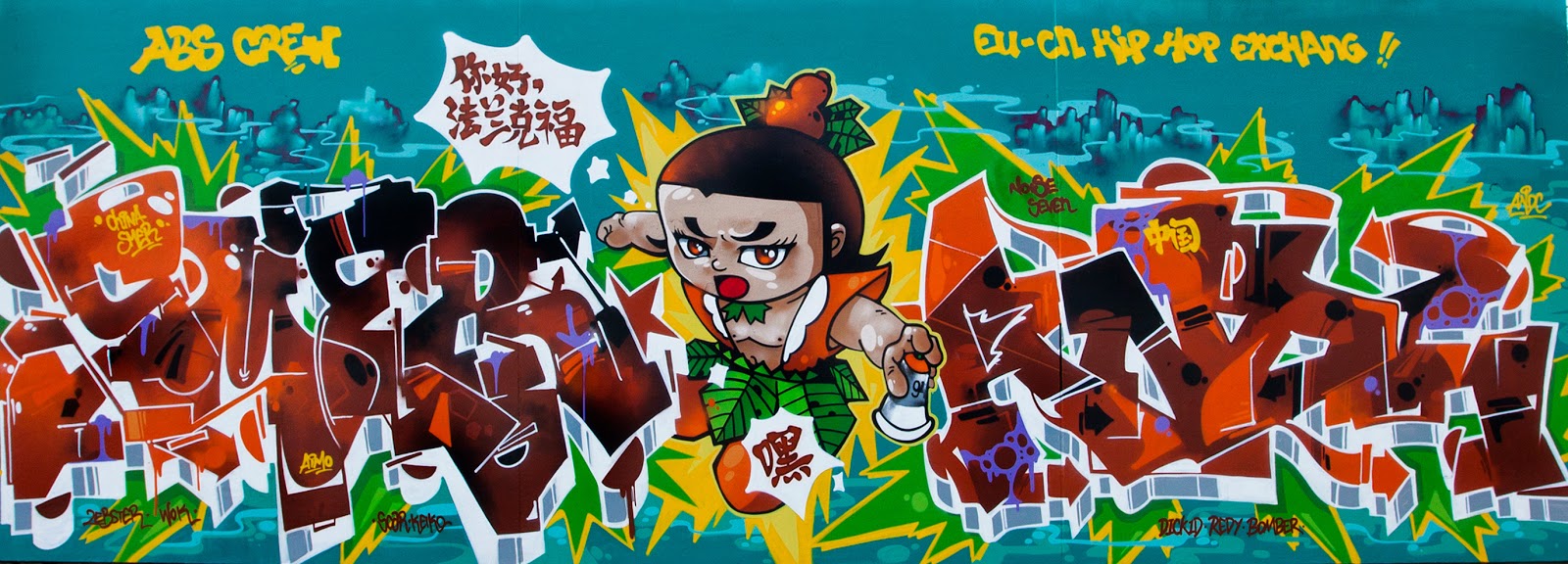
China Flash: ABS Crew: graffiti artists on legal, semi-legal and illegal street art

This is an expanded version of an article which first appeared in Time Out Beijing. All images by and (c) ABS Crew


Deep in the corporate heart of the Central Business District, under the approving eye of a strangely young government representative, a gang of guys in white jumpsuits, industrial respiratory masks and black rubber gloves is painting fierce designs onto ten of the city’s free shuttle buses while an increasing crowd of workers on their lunch break take photos and film their work.


The gang is Beijing’s ABS Crew, who since 2007 have been bringing graffiti culture, hip-hop, film-making and breakdancing together in a successful and classically Chinese combination of countercultural styling underscored by mainstream business acumen. ABS Crew - who go by the names ANDC, Scar, Noise and Seven- own a shop, host cultural events, work with major companies on corporate branding and graphic design, consult with big business and undertake public art commissions. They even sell ABS Crew merchandise. In the next few months alone they’ll be painting at a major music festival and working on a commission in Sanlitun.

Crew member ANDC explains, “Graffiti is very new in China, maybe only ten years old. Young people had to research and seek out the work by studying other countries’ graffiti culture online. When we started, we had no spray cans, just factory grade stuff you couldn’t paint with. We started off in different cities and found each other by uploading our work on the Internet.

But now, young guys are into it, more people are joining in. When we started out, we were studying at university and spent half our time working [in unrelated jobs] for big companies and the other half of our time doing graffiti. Now we do it full time. But we need more money for the culture, because more people want to learn how to do it, but don’t know how. We use business money to create a real culture and we make it available for everyone. We have a lot of plans. In China, if you know a lot of people, you get a lot of business.”


ANDC points out that graffiti occupies a rare position in China: “It’s harder and more illegal in other countries – graffiti-ing buses is illegal in Europe. But in China graffiti is half legal, half-illegal. There are certain areas where it’s okay to do it. This bus project is for the Central Business District’s art festival. We know the government leader for the festival and he’s very young, he’s not an old man, so we were talking with him about how to do fresher projects [and he agreed].”

This appearance of cultural openness is somewhat misleading. I’m talking to ANDC less than 2 hours after the police raided a major Japanese company’s annual sushi-and-cocktails party in epicentre-of-Beijing-cool Sanlitun, saying it was too noisy (but possibly just seeking a kickback) and a week after they raided a music venue, forced gig-goers to undergo mandatory urine tests for drugs and deported any foreigners who tested positive. Two nights ago, groups of silent, uniformed guards appeared at each corner of the intersection closest to my house, armed with machine guns.

While ABS Crew may be pursuing a lucrative corporate strategy these days, ANDC still makes sly reference to their shadier work, done “on a real street, in the night. It’s about wanting to tell people something. We do artwork that’s a social commentary and we add our crew’s name.”

To read my China Flash series of articles about contemporary China, please click here. or explore some of the links below:

Sunday, 21 September 2014

China Flash: Even afternoon tea says something about modern, monetised Beijng

Afternoon tea at The Opposite House, in association with Jo Malone

This is a greatly expanded version of a short write-up which first appeared in Time Out Beijing where I did a brief stint as Deputy Editor. To read my China Flash series of articles about contemporary China, please click here.

Finally, an afternoon tea that smells as good as it looks. Opposite House, the chic Sanlitun hotel, is launching a month long celebration of perfume and pastries, scent and scones. In association with British lifestyle brand Jo Malone, the hotel will be serving an afternoon tea inspired by Jo Malone’s Peony and Blush Suede collection at 3pm every day from 22nd September until 24th October. Hosted at their sleek, warm-toned Mediterranean restaurant Sureño and designed for elegant ‘ladies’ who care as much about fashion taste as food taste, the experience includes a vial of Peony and Blush Suede perfume and a voucher for an arm and hand massage at Jo Malone’s Beijing boutique. 

Obviously it feels nice to spend a couple of hours slotting flavour-bomb pastries into one’s mouth in a flatteringly lit restaurant at a hotel full of attentive staff and beautiful patrons while a shoot for an international fashion magazine goes on upstairs, as it was the day I went.

The tea itself is as classy and considered as the fragrances and scented candles Jo Malone is famous for. I am treated to delicately sliced sandwiches whose bread is baked on-site, filled with tender crab, gutsy smoked salmon and creamy mozzarella; a colourful assortment of miniature cakes including a delicious macaroon that melts into a crush of crumbs and strawberry goo and a bright drum of citron tart; a soft peony-infused cream pot that comes with its own little bone china teacup and edible flower; and best of all, the golden, home-baked scones sitting like a line of tanned knees, rugged on the outside, soft on the inside, served with strawberry rose jam (again made on-site), organic acacia honey and Devonshire clotted cream. My cream was as runny as petrol, but never mind. The whole thing was fab.

“Everything is imported,” the Chinese person I’m with assures me. That is the new China: everything is imported. The country which is famous for its manufacturing and export for foreign companies has absorbed and internalised the value those brands place on themselves. What is considered good in China is foreign.

Afternoon tea is part of a Beijing trend for dainty, English-style pastimes. Or not so dainty: I am considering running a campaign against the cheap, sugar-reeking patisserie and bakery places that have opened up across the city, their displays piled with breads, brioches, biscuits, cakes and tarts all of exactly the same beige carb colour. Like the rest of the world, China’s youth are taking on an American style processed diet of over-refined, high carb, high sugar, high corn syrup, sponge-textured junk that’s making them fat and giving them heart disease and diabetes in the space of a single generation, assisted by an increasingly sedentary lifestyle plugged up with video games, Net surfing and mobile phone chatting.

Back to the tea.

“The hotels don’t [usually] do bilingual flyers,” says my companion, showing me a leaflet for the afternoon tea, which is in both Mandarin and English. “In Beijing it used to be the foreigners that had the money. Now it’s the Chinese that have it. Beijing has the richest people in China.”
“Where does the money come from?” I ask.
“A lot of it’s new money. There are provinces with coal.”
“You’re talking about land sales and the licensing of mining rights.”
My companion nods.
“They make money like water flowing,” she says.

The afternoon tea sits alongside a relatively recent fad for heavily iced multi tier cakes and Disney princess wedding dresses, usually combined with plasticky perfect, unwittingly kitsch Stepford photo shoots to prove that an immaculate investment – I mean a momentous sacrifice – I mean a loving union – is taking place. The era and customs these trends reference never existed. It’s all a cartoon, an inauthentic, retrogressively feminine, Americanised fantasy about a historically hazy England where decorum ruled and social rank was set, stable and (in reality) stifling.

There is also a roaring trend for highly trained ‘English butlers’ over here. That’s one of the most lucrative of these ‘lifestyle’ jobs. I quite like the idea of the rich Chinese employing Little Englanders (ordinary Joes from bog standard Brit towns) to apparently confer some class and style but actually to be their dogsbodies.

“You have to understand that even ten years ago, Beijing was completely different,” says my companion. “These malls you see are being built after the hutong [traditional neighbourhoods with narrow lanes and black curved-slate tiled roofs] were demolished. I was here when the last family was evicted to make this development. That’s happening all over the city. It’s not a question of whether the hutong are beautiful, or characterful, or not. This development is ‘progress’.”

The Opposite House opened six years ago, the same day as the Beijing Olympics. It’s part of the new Beijing, the one that will probably become a single huge mall with internal streets and its own subway system. The hotel is in what is known locally, with heavy euphemism, as ‘the village’ – an enormous luxury shopping, food and lifestyle complex whose formal name is Taikoo Li. There are Balmain, Alexander McQueen, Carven, Balenciaga, Versace and Miu Miu boutiques. All empty. A 24 hour Starbucks. Beautiful girls everywhere, clicking on their phones, wonderfully dressed but with nothing to say, sugar daughters waiting for sugar daddies.

“I find the sight of these girls so depressing,” I say. “They’re so wonderful, so beautiful, so well-dressed. But I don’t see them laughing or joking. They don’t look like they’re having a good time. I don’t get it. And what do they do all day?”
“You only have to look at China’s history. Concubines.”

I say nothing. The Orientalist obsession with forbidden cities, palace compounds and the concubine system of institutionalised sexual exploitation neatly skips over the ‘revolution’ that was designed, deliberately, to break down the idea that women were objects to be bought, reared, sold, used and exchanged for sexual labour. Instead it put forward the idea that women could be used for any labour whatsoever.

“A lot of the girls in universities are being kept,” says my companion.

Again, I say nothing. It is not true that “a lot” of female university students are being sexually used, dressed, accessorised and paid for by the exploitative men they believe are their boyfriends and providers. But there is certainly a minority of younger women, highly visible around Sanlitun in particular who are like beautiful, precious-breed strays sniffing around melancholically for a new owner. The fact that they are visually striking makes them seem more numerous than they really are. The truth is that the majority of Chinese girls and women study and work and work and work, while withstanding pressure to court and marry and breed. And then they work and work and work at being a wife and mother and daughter and daughter-in-law, in addition to their other work.

“You know the new trend is for etiquette classes?” says my companion. “Even three week courses at finishing schools in Switzerland? Because the new Chinese rich are not sophisticates. They have to learn it all. They have no manners. They don’t know how to do anything.”

In this new world anything, even social skills, can be monetised and sold back to you. I have a (Chinese) friend whose cruel but lucrative side business is to give extremely over-priced wine and gourmet food tutorials to her newly wealthy compatriots, who believe anything she tells them.

At Taikoo Li there’s an Apple store whose glowing Old Testament apple logo (Eve bit the apple of temptation and iPods poured out, damning humankind and blighting the earth) is so aggressively huge, hanging heavily over the complex, that I often mistake it for the moon when I’m walking home. Opposite Taikoo Li is a stretch of nasty-looking bars with skinny young men outside, hair spiked, dressed sharply in Korean pop style shrunken suits, trying to entice people inside. Next to the bars is a mammoth zone of international embassies with fierce young guards keeping watch, clicking their heels together, chests out, buttocks taut. This morning I saw just three of them marching down a regular street in odd-numbered formation, silently, left, right, left, right, legs straight and high and in time, eyes ahead, like automata.

There’s also a Soviet era diplomatic residence compound that’s like a suburb in itself, housing the families of the diplomatic staff attached to all the different countries’ embassies. It’s built along classic Chinese/Russian communist-chic lines: huge boxy living room, high ceilings, oddly thick walls between the master bedroom and the adjoining room, either for sexual discretion or to contain the bundled wires and strategically threaded mics needed for clear tapping and surveillance.

“The place is enormous,” says my friend from [Feministania], “yet whenever there’s another family also from Feministania they put us in the same tower of the same block. They want us to talk to each other. With the families from all the other different countries, we are polite, we talk about the weather. With other people from Feministania of course we talk about politics.”

“Assume everything you’re saying is being heard. That’s what I was told when I arrived at my office,” said another friend, who works across politics and global finance.

To walk through Beijing today is to negotiate an ever-spreading grid of malls filled with Western European and Scandinavian lifestyle brands, nearly all of them associated with making over the body in some way. They offer clothes and jewellery, scent and makeup, all priced painfully high to accommodate the luxury goods tax. Nearly all the creams and body lotions, including underarm deodorant, contain whitening products and are called Lunar Glow or Pearl Shine or Moon Caress or somesuch. It’s best to look pale, untouched, dewy, delicate: a conflation of racial and gender judgements. Darkness is ugly, it means hard unfeminine work in rural areas, it means you’re not the preferred Han ethnicity but one of China’s many racial minorities from a far-off region, here to do menial or manual labour, having zipped everything you own into a checked plastic cube-bag and brought it on the train from one of the western border areas that bleeds into India or Nepal or even one of the mysterious barbarian –stans.

“You’re dark and you have tattoos,” said someone to me when I arrived. “Here, that means you’re poor. Provincial poor.”

Before I get to the Apple store in Sanlitun on my way home I pass one of the slickest buildings near my office. When I first saw it I thought it was a nightclub or a karaoke place. It’s a plastic surgery clinic called My Like. Its logo is the outline of a mermaid swimming up the side of the white building, with big bazongas and flowing hair. China’s one of the largest markets for plastic surgery globally, alongside Brazil and Korea. When the sun sets the gleaming white clinic lights up with lines of blazing neon pink.

Back to the tea.

Those aspects of the afternoon tea experience which were not directly within The Opposite House’s immaculate control fell short. To be blunt: the Jo Malone fragrance was laughably small. It was exactly the same as a sample you can beg from any woman at any beauty counter at any bog-standard outlet from Chengdu Airport to an Idaho mall. When I got home, me and my roommate – a lifestyle photographer who has a wine fridge filled with rare perfumes worth tens of thousands of dollars – screamed with mirth when inside my ribbon-tied Jo Malone bag we discovered….another, much tinier ribbon-tied Jo Malone bag, which contained….what looked like a Jo Malone matchbox… which contained what could only be called a ‘vial’ of perfume if looked at through rose-tinted binoculars by a pathological liar.

I had been a longtime admirer of Jo Malone, both the woman and the brand she built single-handed. I am shocked that a marque of such apparent sophistication would do something so unstylishly tight-fisted that my disgust is superseded by ridicule. The lavish booklet that accompanies the ‘vial’ (written, tellingly, all in Chinese apart from its headings, to court that new young rich generation of capitalist aspirants) actually has an entire page entitled ‘The Art of Gift Giving’, showing a male model holding an abundance of normal-sized boxes filled with goodies. If only someone at Jo Malone had followed their own advice.

My favourite Jo Malone scents are Pomegranate Noir, 154 and Red Roses but everyone will have their preferences. I would suggest that any fragrance brand wanting to match the culinary skill and presentational dedication of the Opposite House offer either a genuinely medium-sized wardrobe of multiple scents or a single large perfume of choice to customers who have paid for something special. They – we – are not to sign up, pay up and then be palmed off with something a princessy toddler would get in a novelty gift bag at going-home time.

Looking at the insultingly small offering, I wonder if there is some cultural disdain behind it. Do companies think they can fob off the Chinese with these minuscule trinkets because the Chinese will be happy to get their hands on something, anything, a Western brand gives them, no matter how meagre? Do they think the Chinese are so stupid and so desperate for a little acknowledgement by an English-branded company (which is actually American-owned: Jo Malone was bought by Estée Lauder in 1999) that they’ll be grateful for this pathetic sop? Equally, is China so in thrall to a fantasy version of the Western ‘lifestyle’ that it will overlook homegrown enterprises, no matter how nascent, to court an established brand that does not reciprocate its interest or its appreciation?

The Opposite House are already in talks with a range of (Western) brands to work on collaborations for 2015, while gearing up for a second major pairing this autumn: from October 13th to October 24th they partner with Brit designer Paul Smith for a business set lunch, also at Sureño, with a menu devised by prodigal chef Laia Pons Gonzalez. Paul Smith will be giving away a typically quirky notebook patterned with musical notes, a key motif in the label’s collection at this year’s Paris Fashion Week.

It’s a good idea for The Opposite House to host experiences alongside fashion and beauty brands who match their standards and style. However, those brands will have to step up instead of donating some samples they found in the back of the cupboard and putting them in fancy bags with a ton of marketing material thrown in to add insult to injury. The people who come to The Opposite House are chic and wealthy enough to have entire shelves of properly packaged, full-sized products by brands even more elevated than Jo Malone and Paul Smith. Those same people are well-connected if not outright famous in the very sectors in which the brands wish to maintain prestige; if an experience fails to live up to promises or expectations, they’ll walk. 

The Opposite House host a non-branded afternoon tea throughout the year. Although the flavours are slightly different it’s just as sumptuous, just as delicious, just as stylish and just as affordable as the Jo Malone collaboration. Western lifestyle brands who want to get in on the 21st century capitalist China act must match The Opposite House’s quality and generosity or risk looking commercially cheap and culturally nasty by comparison.